

If you’re researching business phone service, you’ve likely come across the term VoIP. But what does it actually mean—and how does it impact your business?
In this guide, we’ll explain what VoIP is, how it works, and what Twin Cities businesses should consider when evaluating modern voice solutions—from full phone systems to SIP trunks and POTS line replacement.
What is VoIP?
VoIP (Voice over Internet Protocol) is a technology that allows voice calls to be made over an internet connection instead of traditional copper phone lines.
Rather than using dedicated phone circuits, VoIP converts your voice into digital data and securely transmits it across your network.
VoIP can power a wide range of business communication solutions, including:
- Unified communications platforms aka cloud-hosted phone systems
- SIP trunking and VoIP PRI for on-premise phone systems
- Replacement for traditional POTS (land) lines (fax lines, elevator lines, fire alarm lines, etc.)
How does VoIP work?
At a high level, VoIP works by converting your voice into small data packets that travel over your network in real time.
Here’s a simplified version of what happens during a call:
- Your voice is captured by a VoIP-enabled device (In a hosted phone system, this may be a desk phone, mobile app, or computer. With SIP trunks or VoIP lines, this is a device your VoIP provider installs at your office.)
- It’s converted into digital data packets
- Those packets travel across your Local Area Network (LAN) and internet connection
- The VoIP provider routes the call to its destination
- The data is reassembled into audio on the receiving end
This process happens almost instantly, creating a seamless calling experience.
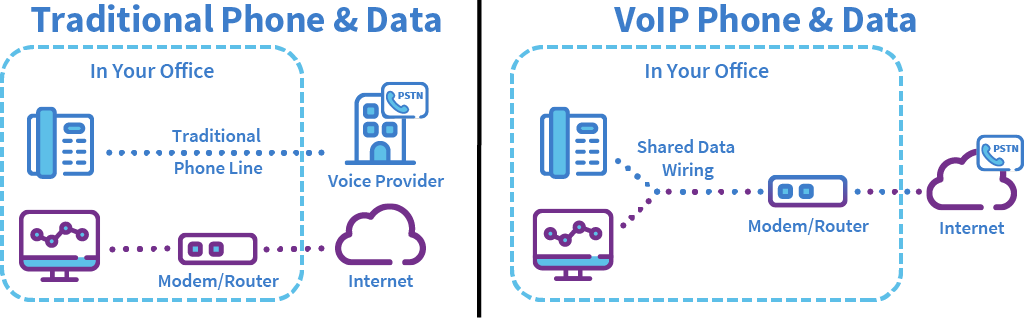
Why Twin Cities Businesses are Switching to VoIP
Businesses across Minneapolis–St. Paul are moving to VoIP for a combination of cost savings, flexibility, and future-readiness.
Lower Infrastructure Costs
VoIP allows voice and data to share the same network, eliminating the need for separate cabling and reducing maintenance costs.
Support for Modern Work Environments
With a cloud hosted VoIP phone system, employees can make and receive calls from anywhere—office, home, or mobile—using the same business number.
More Than Just Phone Calls
VoIP enables Unified Communications (UC/UCaaS), bringing together:
- Voice
- Chat/Messaging
- Voicemail
- Fax (yes, still relevant in some industries)
The Decline of Traditional Phone Lines
Legacy copper-based phone lines are being phased out following the Federal Communications Commission’s deregulation of legacy services.
If you’re still using traditional lines, now is the time to start planning your transition.
VoIP Reliability: What You Need To Know
A common concern is whether VoIP is reliable enough for business use.
The reality: modern VoIP is highly reliable—when properly designed and implemented.
Earlier VoIP implementations sometimes struggled with call quality and dropped calls due to limited internet bandwidth and poor network configurations. Today, with better infrastructure and best practices, those issues are largely avoidable.
Reliability comes down to two key components:
- Your internet connection
- Your internal network (LAN)
VoIP and your Local Area Network (LAN)
Your LAN connects all devices in your office—phones, computers, and wireless devices.
Reliability
High-quality network equipment (switches, firewalls, cabling, WiFi) is essential. Poor hardware or misconfiguration can impact both voice and data performance.
Voice Quality (QoS)
Voice traffic must be prioritized over other network activity.
This is done using Quality of Service (QoS) settings, which ensure that call audio is not disrupted by:
- Large file downloads
- Cloud applications
- Streaming traffic
Proper QoS configuration is one of the most important factors in VoIP performance.
VoIP and your Internet Connection
Your internet connection carries calls between your business and your VoIP provider.
Reliability
While many providers suggest using a single internet connection, this creates a single point of failure.
A more reliable approach is:
- Dual internet connections,
- From different carriers,
- With automatic failover configured in your firewall.
If one connection goes down, the other takes over automatically—keeping your phones operational.
Voice Quality
VoIP uses relatively little bandwidth, but it requires:
- Stable connectivity
- Low latency
- Minimal packet loss
Before upgrading bandwidth, it’s worth evaluating your actual usage.
Types of VoIP Solutions for Businesses
VoIP isn’t just one thing—it supports several different types of business communication solutions:
Cloud-Hosted VoIP Phone Systems
A fully managed business phone system delivered over the internet.
➡️Explore POPP’s cloud hosted VoIP phone system solutions
SIP Trunking / VoIP PRI
Connects your existing on-premise phone system to the internet, replacing traditional circuits.
➡️Explore POPP’s VoIP services for your existing on-premise phone system
POTS Line Replacement
Allows legacy devices like:
- Alarm systems
- Elevators
- Fax machines
to operate without traditional copper lines.
This flexibility is one of the biggest advantages of VoIP—it adapts to your business, rather than forcing a full rip-and-replace.
➡️Explore POPP’s POTS Line replacement options
The Bottom Line on VoIP
VoIP has become the standard for modern business communications.
It offers:
- Greater flexibility
- Lower long-term costs
- Support for hybrid work
- A path forward as legacy phone lines disappear
However, the key to success is proper design and implementation—especially when it comes to network configuration and failover planning.
Ready to Explore VoIP for Your Business?
Choosing the right VoIP solution isn’t just about technology—it’s about reliability, support, and long-term fit. We can help you design the right solution for your business.
 What Is a Cloud VoIP Phone System (and Is It Right for Your Twin Cities Business?)