

If your business still relies on traditional landlines—also known as POTS (Plain Old Telephone Service)—you’re not alone. But across the country, businesses are discovering that these legacy copper phone lines are becoming more expensive, harder to maintain, and increasingly difficult to keep in service.
For many organizations, this shows up as:
- Sudden monthly price increases
- Notices from carriers about discontinued services
- Difficulty moving or adding lines
- Aging systems becoming unreliable
- Pressure to migrate to newer technologies
The reality is that the telecommunications industry is in the middle of a nationwide transition away from copper-based infrastructure.
And for businesses that still depend on analog lines for phones, alarms, elevators, fax machines, or other critical systems, now is the time to understand what’s changing—and plan ahead.
What Is a POTS Line?
POTS stands for “Plain Old Telephone Service.” These are traditional analog phone lines delivered over the old copper wire network in the ground or on telephone poles between your office and your neighborhood CenturyLink/Lumen Central Office telecom building. For decades, copper networks were the backbone of business communications. They powered:
- Business phone systems
- Fire alarm panels
- Security systems
- Elevator emergency phones
- Fax machines
- Point-of-sale systems
- Modems and monitoring equipment
These lines were known for their simplicity and reliability. But the technology behind them was designed for a very different era of communications.
Today, most business communication happens over:
- Internet-based phone systems
- Fiber connections
- Cellular networks
- Cloud communications platforms
As a result, the number of businesses still using traditional copper lines has declined dramatically.
How to Tell If Your Business Still Uses POTS Lines
You may still have traditional analog lines if your phone bill includes terms like:
- POTS Line
- Analog Line
- Business Line
- Central Office Line
- Alarm Line
- Fax Line
You may also have copper-based services if:
- Your alarm panel does not have cellular monitoring
- Your elevator phone uses a standard analog line
- Your fax machine plugs into a telephone wall jack
- Your business phone system is several decades old
Many businesses are surprised to discover how many active copper lines still exist throughout their organization.
Why Telecom Carriers Are Retiring Copper Networks
The shift away from copper isn’t arbitrary. It’s largely driven by economics and infrastructure realities.
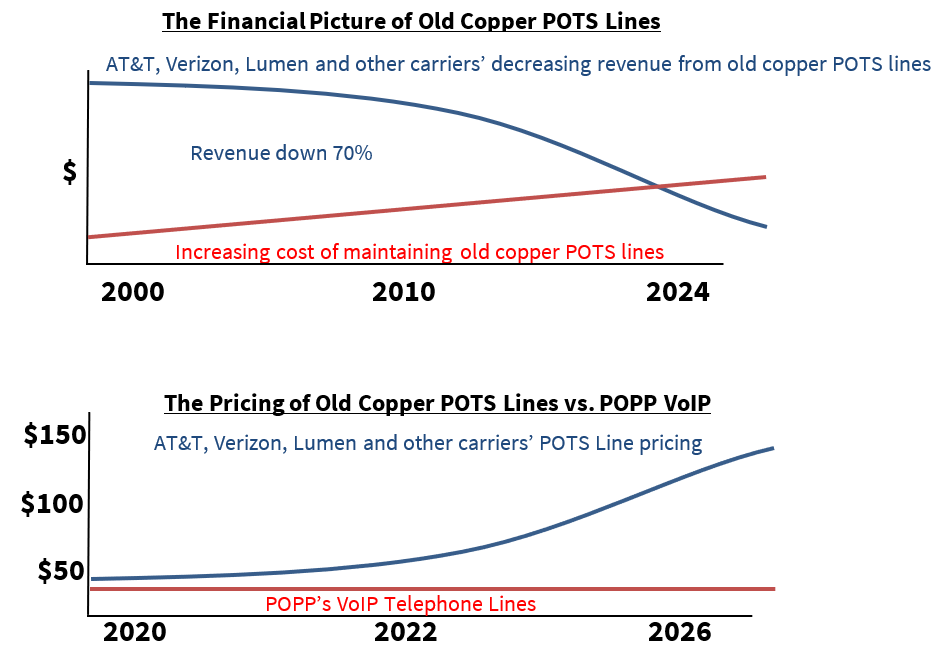
For telecom carriers, maintaining aging copper networks has become increasingly difficult and expensive:
- Fewer customers remain on copper services
- Revenue from analog lines continues to decline
- Replacement parts are becoming harder to source
- Skilled technicians familiar with legacy infrastructure are retiring
- Severe weather and aging facilities increase maintenance demands
At the same time, carriers are investing heavily in:
- Fiber networks
- Wireless infrastructure
- IP-based communications systems
In simple terms, providers are spending more money maintaining infrastructure that fewer customers still use.
For many businesses, this explains why monthly charges for analog lines have risen sharply in recent years. Carriers are attempting to offset the growing cost of maintaining legacy infrastructure.
The FCC’s Role in the Copper to VoIP Transition
In 2019, the Federal Communications Commission adopted Order FCC-19-72, which allows regulations set back in 1996 to expire, giving Incumbent Local Exchange Carriers (ILECs) like AT&T, Verizon, and CenturyLink/Lumen freedom from price controls and wholesale requirements.
The FCC’s aim is to relieve ILEC’s across the nation of the burden of maintaining the legacy copper network, to accelerate investment in broadband and “Next Generation Networks”, namely Voice over IP (VoIP).
You can view the FCC order here: FCC Order FCC-19-72
This accelerated a transition that was already underway across the telecommunications industry.
For businesses, the practical impact has been significant:
- Faster copper retirement timelines
- More aggressive migration efforts from carriers
- Reduced availability of traditional analog services
- Increasing pressure to move to modern alternatives
What Systems Still Depend on POTS Lines?
Many businesses are surprised to discover how many critical systems still rely on analog copper lines.
Common examples include:
- Fire alarm panels
- Burglar alarm systems
- Elevator emergency phones
- Fax machines
- Door entry systems
- Legacy phone systems
- Backup communication lines
- Monitoring equipment
In many cases, these systems may continue working quietly in the background for years—until a carrier discontinues service or a line fails. That’s why proactive planning matters.
The 4 Most Common Ways POPP Helps Businesses Replace POTS Lines
Not every analog line should be replaced the same way.
The right solution depends on:
- What the line currently supports
- Whether the system is safety-related
- Whether an internet connection is available for VoIP
- What level of reliability or compliance is required
At POPP, most business POTS replacement projects fall into one of four categories:
1. Cloud Phone Systems
Best for: Replacing traditional business phone systems
For businesses still using analog or legacy digital phone systems, one of the most common upgrades is moving to a modern cloud phone system. A cloud phone system utilizes VoIP (Voice over IP) technology, which works over your internet connection instead of copper phone lines.
This approach allows businesses to:
- Eliminate expensive analog line charges
- Modernize aging phone equipment
- Support remote and hybrid employees
- Add advanced business calling features
- Scale more easily as the business grows
For many organizations, this becomes both a POTS replacement project and a broader communications upgrade.
Cloud phone systems often include:
- IP desk phones
- Softphone calling apps for smartphones and computers
- Auto attendants and call routing
2. Internet Phone Service
Best for: Non-safety analog lines like fax machines or single-purpose devices
Some organizations simply have standalone analog lines that still serve a specific purpose, such as:
- Fax machines
- Courtesy phones
- Gate systems
- Credit card terminals
- Miscellaneous analog devices
In many cases, these lines can be replaced with individual Internet phone service lines instead of maintaining costly copper service.
This approach allows businesses to:
- Reduce monthly carrier costs
- Eliminate dependence on copper infrastructure
- Modernize service without replacing larger systems
POPP VoIP Lines are a simple and direct replacement for many POTS lines. A POPP technician installs an Analog Telephone Adaptor at your site and performs the conversion with only momentary downtime. POPP VoIP Lines work just like POTS lines, with the same dial tone, phone number and line features.
For non-safety applications, this is often one of the simplest and most cost-effective migration paths.
3. Wireless Phone Service
Best for: Elevator phones, fire alarm panels, security systems, and life-safety devices
Some systems require a different approach entirely. Safety-related systems often require:
- Independent connectivity
- Reliable uptime
- Battery backup capability
- Code compliance considerations
For these applications, POPP commonly deploys Wireless Phone Service.
These systems:
- Replace copper lines with secure cellular connectivity
- Operate independently of internet service
- Include built-in battery backup
- Continue supporting many existing safety devices
They are commonly used for:
- Fire alarm panels
- Elevator emergency phones
- Burglar alarm systems
- Monitoring equipment
- Analog lines where no internet connection is available
POPP’s Wireless Phone Service provides a dual connection using VoIP and cellular technology and comes with an 8-hour battery backup service. Since this service provides cellular backup in the event of an internet outage, and battery backup in the event of a power outage, this service meets the NFPA72 – City Fire Code Requirements.
Wireless Phone Service is designed for fire alarm panels and elevator phones, however any analog device that you wish to have cellular and battery backup are good candidates, including essential fax lines, monitoring lines, credit card lines, door entry lines, etc.
4. Special Telephone Numbers
Best for: Retaining important business numbers without maintaining a physical line
Some analog lines still exist primarily because the business wants to keep the phone number.
Examples include:
- Old published business numbers
- Legacy fax numbers
- Marketing numbers
- Backup lines that rarely receive calls
In these situations, maintaining a full copper line often no longer makes financial sense.
One alternative is converting the number into a Special Telephone Number that simply forwards incoming calls to another destination.
This allows businesses to:
- Preserve long-standing phone numbers
- Eliminate unnecessary analog service costs
- Remove copper infrastructure
- Continue receiving important calls
For legacy phone numbers, this can be one of the simplest and lowest-cost solutions available.
What Happens If You Wait Too Long?
Many businesses delay upgrading because:
- “The line still works.”
- “We only use it occasionally.”
- “We haven’t had problems yet.”
But waiting can create unnecessary risk. As copper retirement accelerates, businesses may face:
- Sharp monthly cost increases
- Limited replacement timelines
- Service interruptions
- Emergency migrations under pressure
- Compliance concerns for safety systems
Planning ahead typically leads to:
- Better replacement options
- Lower disruption
- More predictable costs
- Smoother transitions
The Bottom Line
The transition away from copper infrastructure is already underway across the telecommunications industry.
Between:
- rising maintenance costs,
- declining copper usage,
- carrier modernization efforts,
- and regulatory changes like FCC Order 19-72,
traditional analog phone lines are becoming increasingly difficult and expensive to maintain.
The good news is that POPP offers multiple paths forward depending on what those lines actually support.
For some organizations, that means upgrading to a modern cloud phone system.
For others, it means replacing standalone analog lines with Internet Phone Service lines.
Safety-critical systems may require Wireless Phone Service with battery backup and independent cellular connectivity.
And in some cases, businesses simply need to preserve an important phone number through call forwarding using a Special Telephone Number.
Next Steps
If your business is in need of guidance to navigate the change from land lines to reliable VoIP service, please contact us and our advisors will work with you to create a plan to update your technology.
Links to Google Searches to Learn More:
What is the average cost of POTS lines today?
Are POTS lines being phased out?
Still Paying for Copper Phone Lines?
We’ll help you identify your POTS lines and recommend the most practical replacement option—whether that’s VoIP, cellular connectivity, or simple number forwarding.
 5 Call Recording Benefits: Is It Worth It For Your Business?